



The Modern Use of Fur in Fashion
Construction, craft, and the shift from volume to technique
Fur is far from dead in fashion. In fact, it’s as culturally pervasive as ever. Fur's function was to be sold in department stores around the world, produced at scale to capitalize on mid-century American affluence, and dressed by women who wanted to look like they just stepped out of Bergdorf's, regardless of where they actually were.
The fur coat hasn't disappeared. It has been recalibrated for what people actually wear today and how they wear it.
Fur shows up now in intermittent doses. As accents on clean-lined outerwear, as engineered components sewn into garments with technical precision, as removable liners that increase a jacket's versatility across seasons. Modern fur functions most commonly as part of a whole rather than as a whole itself. Pull back far enough, and you’ll find historical roots to every modern practice. What feels so new about the way fur is used now is connected to everything that came before it. Consider this an inverse history lesson: how fur got to where it is today by understanding where it is today.
Fur As Volume
"Fur worn as a coat" is the baseline against which all other uses are measured. The notion of fur-as-volume applies almost exclusively to the full-length fur coat worn as outerwear: collected on the chest, cascading to the ground. The standards of construction were once universal but have since dwindled: whole skins laid together or let-out skins stitched to create a continuous surface.
These standards changed as the industry transitioned from a made-to-order to a ready-to-wear business model in the mid-twentieth century. Ready-to-wear shortened production timelines, mandated smaller output quantities, and allowed for little error margins. Fur that once took months to render required anywhere from a few days to just a few hours.
Applied volumes of fur became more manageable. Designers subdivided full-length coats into comprehensible parts such as trim, liners, handbags and understood material at retail prices rather than manufacturer prices
Why Fur Today Is Different (And Better) Than Fur Of The Past
The modern fur coat requires more skill to execute than its historic equivalent. Contemporary fur garments require some amount of sewing them together, but focus more on sewing fur into something else. Today’s fur is less obvious, less easily identifiable, and far better made.
Fur coats still serve the purpose of keeping their wearers warm. Beyond that, the ways in which we use fur today are constantly evolving. Below are six examples.
Fur As Trim
Large swaths of fur are no longer the most popular way to incorporate fur into wardrobes and production runs. Instead, accessories account for a large portion of fur used today, as trim across garment types.
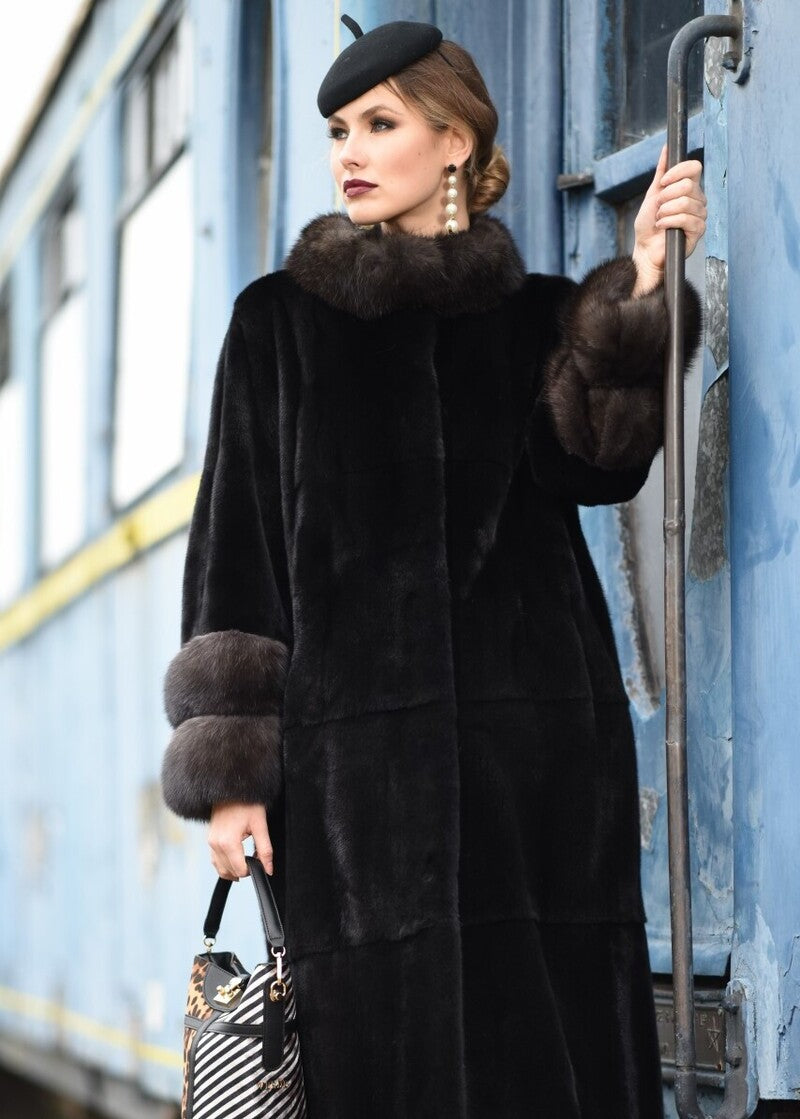
Hat makers use fox, rabbit, and muskrat. Glove makers use fox and mink. Bags use a stable of exotic species like badger, lynx and mink. Fur trimming acts as a whisper, not a shout.
Where full-length fur coats were constructed in one piece, trim require fur be joined with other materials.
Absorbing textile's nap direction and weight ensures fur trim move with the rest of the garment and do not distort overall fit.
2. Hybrid Materials
Cashmere coats with fur linings, wool coats with fur trim, fur collars on leather jackets. Blending fabric technologies is not new, but achieving seam parity between two different materials is an elevated skill.
Constructing a coat that combines knit with downfill, for example, depends on adding an interlining that will make both feel like one. With fur garments, there’s an additional textural element involved. Cashmere coats with fur linings are common, but lining a cashmere coat with fur requires solving weight disparity without compromising the drape and fit of the cashmere coat itself.
3. Removable Parts
Few people buy a new coat every time the weather turns cold. Historically, that meant buying a heavy winter coat you lived in from December through March and stored at the back of your closet for the rest of the year.
Warmth became a toggle you flipped rather than a state of being. The ability to remove fur components extends garment lifecycles and allows customers to swap resource-intensive materials (like fur) for ones with different seasonal and textural performances.
Areas where fur is removable include:
Detachable collars and hoods
4. Reversible Pieces
Two-sided garments offer twice the utility at the cost of twice the labor. But they also ensure both sides of a garment are finished to the same high standards, requiring sewers to manage things like seam allowances in a way that won’t reveal the shirt on the inside of the jacket.
They’re exponentially more work than single-sided coats.
5. Accessories
No list about modern fur would be complete without including fur accessories. Hats, gloves, collars, bags, jackets, shoes and shawls made primarily or in whole from fur.
Yes, some of these are wildly reduced in size from their original coat purposes. A hat is not a coat, no matter how fancy. But they still require the same skill to produce well and represent entry-level opportunities for makers looking to get into working with fur.
6. Bespoke Fur
Most fur coats today are made to order, not made to stock. Few consumers can afford to buy fully bespoke clothing, garments constructed from the ground up for one person only but buying a made-to-order coat from an atelier allows for increased sizing accuracy, tailor fit, and stylistic control.
These coats aren’t cheaper than the ones sold in department stores half a century ago. But they are exponentially better made.
Why Modern Fur Garments Require Technical Skill
One enduring myth about modern fur is that if there’s less of it, less skill is required to make it. Nothing could be further from the truth.
Even a let-out mink coat from neck to hem, impressive in its own right as a technical exercise exists within a single material logic. The furrier is dealing exclusively with fur. Nap direction, seam matching, blocking and glazing all happen within the world of fur alone. Introduce another fabric into the picture and that logic gets upset. Not only must the furrier now understand how his or her material relates to another materially distinct thing (How does cashmere pull in comparison to mink lining? How does wool behave against a structured fabric when it’s bonded to fur panels? How does the weight of a long-haired fur impact the shoulder and hem fall of a tailored jacket?) but if you’re allowing out the fur itself to create custom sizing or silhouette on a hybrid garment, you must now negotiate those attachment points to the base fabric.
Letting out alone, slicing each fur pelt on an angle into thin strips before re-joining them at an adjusted angle to provide length and fluidity as well as vertical nap, is technical skill. Each pelt can easily yield sixty strips sliced only a few millimetres wide before they’re re-sewn together with seam allowances tinier than most sewers use on regular fabric work. Apply that skill to coordinating fur and base fabrics attached at multiple points around a garment and you’ve introduced new tensions that the letting-out technique wasn’t designed to handle.
Nap direction, or the orientation of the fur’s hair growth, is invisible to a person on the street but glaringly obvious to a trained eye under direct lighting or in photographs. Matching nap direction across all panels and trim pieces used in a fur garment is baseline quality control. In a garment that uses multiple panels with full-skin sections joined to trim sections and elements of hybrid construction? Matching nap direction across multiple methods of construction is a major technical achievement.
As less fur is used in each garment, the skill required to apply it properly has increased exponentially. Modern fur is artisanal work.
The Restoration Economy: Vintage, Inherited, and Remade Fur
While modern fur garments require significantly more technical skill to produce well than fur garments of the past, one of the biggest changes to fur as an aspect of fashion actually has nothing to do with new production at all. It’s what happens to the millions of existing furs already out in the world.
There are three categories in this economy, vintage, inherited, and remade fur, that are consistently conflated by consumers. The lines between them are distinct, and that conflation produces wildly inconsistent ideas about value, process, and cost.
Vintage fur is a fur garment cut during a previous era, usually at least twenty years past, and sold through resale channels. Value is dictated by the type of fur, construction quality, storage history, and condition. Age is just a number.
Inherited fur is a fur garment passed down from one family member to another. Vintage often but not always in age, what distinguishes inherited fur is its provenance. The sentimental value of an inherited fur is not necessarily equal to its material value and vice versa.
Resale fur is pre-owned fur sold through commercial channels. Auction houses, consignment dealers, and specialized platforms all sell resale fur. Documented provenance can affect value when it is available.
Restored fur is pre-owned fur that has been professionally treated for signs of wear and aging: conditioning the leather backing, spot treating damaged guard hairs, re-lining, re-glazing, re-blocking the silhouette, etc. Restoration is not repair. It cannot return a garment to brand new condition, but it can arrest deterioration and restore a fur garment to a condition as close to original as possible.
Remade fur is pre-owned fur that has been cut apart and substantially reconstructed: shortening a coat into a jacket, chopping skins to use as trim on a new garment, using an entire coat to make smaller accessories, etc. Remade fur is new creativity applied to old material. It’s an extension of restoration that uses the original garment as a raw material for something new.
Both remade and restored furs factor into an evolving economic logic that deserves spotlight here. The raw material value of a well-preserved vintage or contemporary fur coat, is not insignificant. When that cost is balanced against the price of remodeling that coat into contemporary jacket, a small suite of accessories, or fur trim on a complementary garment, fur restoration and remodeling suddenly becomes more than just sentimental. It becomes economically sensible.
Real Fur vs. Synthetic Alternatives: A Material Distinction
The distinction between real fur and faux fur coats is most often discussed on ethical grounds. For the sake of making a material distinction here, we’re going to focus on the material comparison.
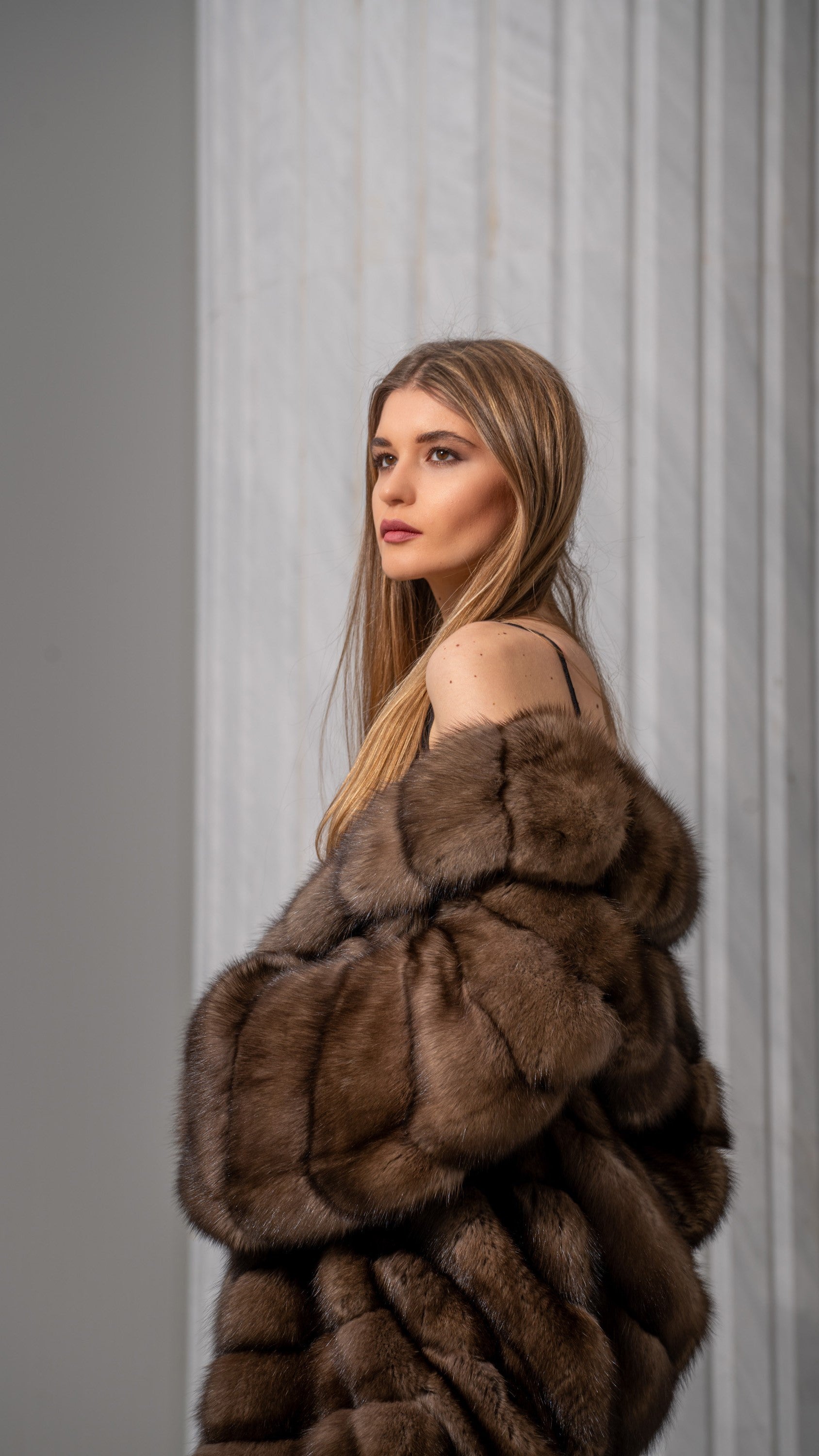
Real fur is animal protein fiber attached to a leather backing. Its warmth comes from the air trapped by its underfur. Its appearance comes from its guard hairs. It is repairable. Guard hairs can be replaced if damaged. Leather backings can be conditioned. Linings can be redone. With care, fur ages well. A 50-year-old fur coat is still a useful material object and can always be professionally remodelled into something new.
Synthetic fur coats are made from a petroleum-based textile designed to mimic the appearance of real fur. Most commonly made from acrylic or modacrylic fabrics, faux fur doesn’t recreate the warmth of trapped air found in real fur, the structure provided by leather backing, or any of the repair options available to real fur textiles. Faux fur wears out easily, mats with use, sheds microfibers, and has limited to no restoration or remake potential. Its lifetime is far shorter, and its end-of-life options more limited than real fur.
They’re not the same material doing the same job. A faux fur trimming on a commercially produced coat is not performing identical material functions to a sable collar on a bespoke overcoat. Comparing them as though they are equivalent or, more egregiously, interchangeable, doesn’t further the material conversation. Faux fur deserves a place in the world. But it’s not the place real fur occupies, and framing one as a functional replacement for the other is simply inaccurate.
Fur In Material-Focused Wardrobe
We live in a world where buying less but better means considering materials as part of your purchasing decisions. Many people focus solely on sustainability metrics, but for anyone thinking about the longevity of their purchases, fur has some distinct advantages.
Constructed well, maintained correctly, and restored when needed, a fur garment can be wearable for fifty years or more. Seriously. Compare that to most fast-fashion outerwear (two to five year functional life span, tops) or even premium wools and cashmere (durable with care, but not repairable) and it’s easy to see how fur outpaces most materials in terms of lifespan.
That longevity is why a multi-decade investment like fur something that can be let out or taken in as your body changes, relined when the lining wears or you want a colour update, reblocked to alter the silhouette or refresh worn areas, and ultimately destroyed or remade into something else when you’re finally done argues for its own category in the material-focused wardrobe. Built to last, but not with a seven-year obsolescence date like fast fashion or disposal recommendations like mass-produced leather, fur is expensive because it has that kind of lifespan.
It’s a logistical argument as much as an aesthetic one. And as more luxury clients consider outerwear investments through this lens, it’s becoming more relevant than ever.
A Material With A Longer History Ahead
Contemporary fur isn’t voluminous, it’s editorial. There are fewer pieces, constructed with greater technical expertise, and intended to serve longer.
Think atelier, not factory. Think material knowledge first, fashion trend second.
Fur hasn’t been pushed out of fashion, it’s moved into a space that requires more knowledge to work with well: on behalf of the maker, the buyer, and the stylist. That isn’t a negative. It’s a positive evolution.
A material’s ability to be repaired, to provide multi-decade service, to be made again - these are fur’s most valuable qualities, and least often mentioned. Within a fashion culture finally waking up to ideas of longevity and invested worth in what we buy and own, fur is one of the only materials with a provable track record of being able to survive generations spiritually and physically intact.
Learning to look at fur on its own terms, as a construction material, an object of maintenance, and a long-term investment, is step one in working with fur well.
Buy well, store it properly, and a century-old fur coat can still provide thousands of hours of use today, and can always be remade to look contemporary. Very few categories of textile can make that claim.